Live gold value tool
Gold Calculator
Calculate the current value of gold by weight, unit, and karat using a live spot-price feed with clear melt value and buyer payout estimates.
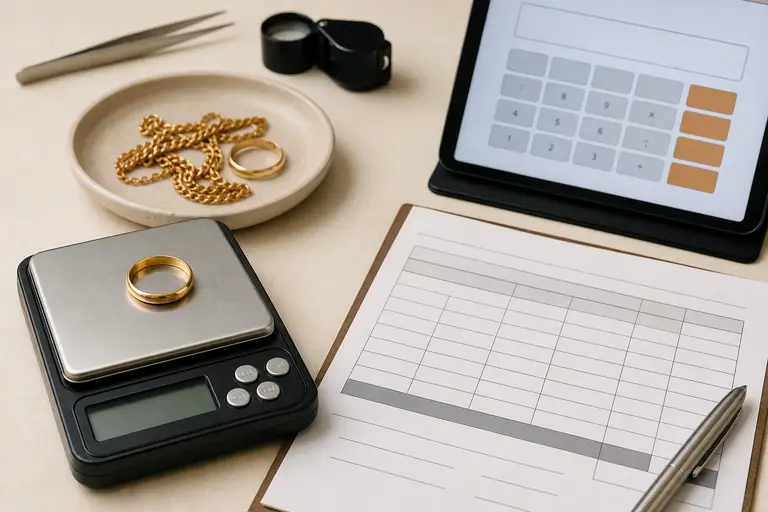
Live calculator
Estimate gold value by weight and karat
Karat price board
Live gold price per gram
| Karat | Purity | Price / gram | 10g melt value |
|---|---|---|---|
| 24K | 99.9% | Loading price | Loading price |
| 22K | 91.6% | Loading price | Loading price |
| 21K | 87.5% | Loading price | Loading price |
| 18K | 75.0% | Loading price | Loading price |
| 14K | 58.3% | Loading price | Loading price |
| 10K | 41.7% | Loading price | Loading price |
| 9K | 37.5% | Loading price | Loading price |
| 8K | 33.3% | Loading price | Loading price |
Values use troy-ounce market pricing. One troy ounce equals 31.1034768 grams.
Quick answer
What this gold calculator tells you before you sell
Use this gold calculator to turn live spot price into a practical melt value for jewelry, scrap gold, coins, or karat gold.
The main job is simple: connect weight, unit, karat purity, and the live gold price per gram. That is why the page targets gold calculator, gold value calculator, scrap gold calculator, and gold price per gram searches in one workflow.
The result is a baseline, not a guaranteed buyer offer. Pawn shops, jewelers, refiners, and cash-for-gold buyers can apply a payout percentage after testing the item and deducting stones or non-gold weight.
Guide
Get a fast spot-based estimate for gold jewelry, scrap gold, coins, or karat gold before comparing buyer offers.
How this live gold calculator works
GoldCalc starts with the live gold spot price per troy ounce, converts it to a price per gram, then applies the purity of the selected karat. A 10 gram 14K ring is not valued like 10 grams of pure gold; it is valued as 10 grams multiplied by about 58.3 percent gold content.
The calculator shows melt value first because melt value is the cleanest baseline for gold jewelry and scrap gold. It then shows buyer estimate ranges so you can compare the metal value with a realistic pawn shop, jeweler, or refiner offer.
Gold price and gold value are the same search task
Most people who search for a gold calculator are trying to answer a practical price question: what is my gold worth right now? That may mean checking the current gold price, estimating scrap gold value, or checking the price per gram for 14K, 18K, or 10K jewelry.
This page keeps those tasks in one workflow. You do not need to know the formula before using it, but the formula is visible so you can check how the estimate was produced.
Use the estimate as a baseline, not a guaranteed offer
Actual buyer offers can be lower than melt value because buyers may deduct refining costs, testing uncertainty, stones, clasps, solder, or non-gold parts. Branded jewelry, antique pieces, and items with significant gemstones can also be worth more than melt value.
For simple scrap jewelry, the spot-based value gives you a useful number before you walk into a pawn shop or send gold to a cash-for-gold buyer.
What to enter before selling gold today
For the fastest estimate, check three things before using the gold calculator: the item weight, the karat stamp, and whether the weight includes stones or non-gold parts. A digital scale that reads grams is usually easier to compare with gold price per gram searches, while dwt is useful when a buyer quotes pennyweight.
If you have several items, sort them by stamp before calculating. A 14K chain, an 18K ring, and a 10K bracelet should not be averaged together because each karat has a different pure gold percentage and a different melt value.
How to read a live gold estimate
The live result is a spot-based metal estimate, not a retail appraisal. The spot price moves during market hours, and buyers may quote from a bid price, an ask price, or their own posted buying price. That is why GoldCalc shows the timestamp and lets you override the spot price when you need to model a buyer quote.
A useful check is to compare three numbers: pure gold price per gram, melt value for your item, and estimated buyer payout. If the buyer offer is far below the payout range, ask which spot price, purity, weight unit, and deduction method the buyer used.
Gold calculator formula with a simple example
The core formula is weight in grams multiplied by purity, then multiplied by pure gold price per gram. Pure gold price per gram comes from the live spot price per troy ounce divided by 31.1034768. That is why the same spot price can produce different values for 24K, 18K, 14K, and 10K gold.
For example, a 10 gram 14K item contains about 5.83 grams of pure gold. If pure gold is worth $135 per gram, the 14K melt value is about $787 before buyer deductions. A pawn shop, jeweler, or online buyer may offer a percentage of that melt value rather than the full metal value.
Gold price per gram today by karat
Many users search gold price per gram today, 14K gold price per gram, 18K gold price per gram, or 10K gold price per gram because they want the number in the same unit used on a scale. The price board above converts the live troy-ounce quote into per-gram values for the most common karats.
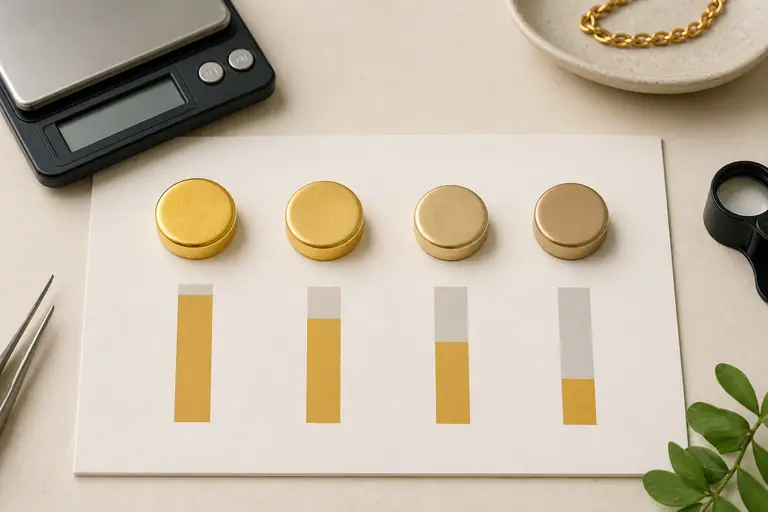
Use the 24K row as the pure-gold reference. Then compare 22K, 18K, 14K, 10K, 9K, and 8K by purity. Lower karat gold can still have real value, but it should never be compared directly with the pure 24K spot price.
Common gold marks and purity shortcuts
Many jewelry stamps use either karat marks or fineness marks. 10K is close to 417, 14K is close to 585, 18K is 750, 22K is about 916, and 24K bullion is commonly marked 999. These marks are useful starting points, but worn stamps, repairs, and mixed parts can still require testing.
Gold plated, rolled gold, and gold filled pieces should not be entered as solid karat gold. Their visible color can look similar, but the recoverable gold content is much lower and often needs a specialist buyer or a separate refining process.
Pawn shop and cash-for-gold payout checks
A pawn shop gold calculator should not stop at melt value. The useful question is how the offer compares with melt value as a percentage. A quick local cash offer may be lower because the buyer is paying immediately, carrying fraud risk, and leaving room for resale or refining.
For small or mixed lots, a lower payout can be normal. For clean, sorted 14K or 18K jewelry, compare more than one buyer when the melt value is meaningful. Ask whether the quote uses grams, pennyweight, or ounces, whether stones were deducted, and whether the price was locked at the displayed timestamp.
When a calculator is enough and when it is not
A calculator is enough for planning and offer comparison when the item is plain karat jewelry or scrap gold. It is not enough for signed designer jewelry, collectible coins, watches, antique pieces, or jewelry with valuable gemstones because those can have resale value beyond metal content.
If the melt value is high, use the calculator as your first number and then compare multiple buyers. For lower-value items, the best decision may balance payout percentage with speed, travel time, buyer reputation, and whether you want immediate cash.
Quick checklist before accepting a gold buyer offer
Write down the item weight, unit, karat, live spot price, calculator melt value, and buyer cash offer. Then calculate the offer as a percentage of melt value. This makes it much easier to compare a pawn shop quote with a jeweler, mail-in buyer, or refinery-style estimate.
Do not compare offers unless the same assumptions are being used. A quote based on pennyweight can look different from a gram quote, and a quote that includes stones or watch parts can overstate payable gold weight. Clean inputs lead to cleaner decisions.
Gold calculator for grams and price per gram
Many people search for gold calculator grams, gold gram calculator, gram gold calculator, and gold calculator price per gram. Those searches all point to the same workflow: enter a gram weight, choose the karat, and compare the result with today gold price per gram.
GoldCalc.im keeps grams as the default because most jewelry owners weigh rings, chains, and scrap lots in grams. Users who have a troy-ounce, pennyweight, standard-ounce, or kilogram quote can still switch units without leaving the calculator.
FAQ
Common questions
How do I calculate the value of my gold?
Enter the weight, unit, and karat. The calculator converts the weight to grams, applies the gold purity, and multiplies the pure gold weight by the live spot price per gram.
Is the calculator value the same as a buyer offer?
No. The main value is melt value. Buyer offers are usually a percentage of melt value after testing, refining costs, and margin.
Why does gold use troy ounces?
Gold spot price is quoted per troy ounce. One troy ounce equals 31.1034768 grams, which is different from a standard ounce.
Can I use this for gold jewelry?
Yes, for metal value. It does not include diamonds, designer value, collector value, or resale premium.
What is the best unit to use in a gold calculator?
Grams are easiest for most jewelry owners. Pennyweight is also common in pawn shops and jewelry buying, so confirm the unit before comparing a quote.
What does 585 or 750 mean on gold jewelry?
585 usually means 14K gold, or about 58.5 percent gold. 750 means 18K gold, or 75 percent gold.
Why did a buyer use a different gold price than the calculator?
The buyer may use a bid price, a delayed posted price, or a buying price below spot. Ask for the spot price and timestamp used in the quote.
Should I calculate each item separately?
Yes when the karat is different. Grouping by 10K, 14K, 18K, and 24K keeps the estimate closer to the real melt value.
Can I use this as a gold calculator for grams?
Yes. Grams are the default input, and the result shows melt value, pure gold grams, and price per gram for the selected karat.
What does gold calculator price per gram mean?
It means the calculator converts the live troy-ounce spot price into a per-gram value, then adjusts that value for karat purity.
GoldCalc provides spot-based estimates for educational and planning purposes. Actual buyer offers can vary based on testing, weight deductions, refining costs, local market conditions, gemstones, brand value, and buyer margin.