Cash offer estimate

Cash for Gold Calculator

Estimate a cash-for-gold offer using live melt value and practical payout ranges for different buyer types.

Live spot price ready Karat purity math Pawn and refiner estimates
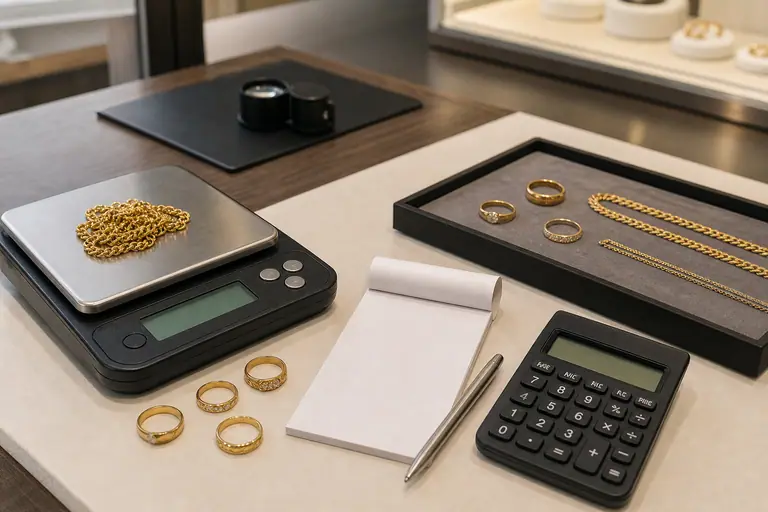
Gold jewelry appraisal desk with scale and calculator

Live calculator

Estimate gold value by weight and karat

Loading price
Adjustments
Spot price$4,200/ozt
Applied purity58.3%
FormulaWeight x purity x spot/g

Karat price board

Live gold price per gram

KaratPurityPrice / gram10g melt value
24K99.9%$134.90$1,349
22K91.6%$123.69$1,237
21K87.5%$118.15$1,182
18K75.0%$101.27$1,013
14K58.3%$78.72$787.24
10K41.7%$56.31$563.09
9K37.5%$50.64$506.37
8K33.3%$44.97$449.66

Values use troy-ounce market pricing. One troy ounce equals 31.1034768 grams.

Live API credentials are not configured yet. The calculator remains usable with fallback pricing.

Cash offer quick answer

Cash-for-gold value is melt value multiplied by buyer payout

A cash for gold calculator estimates the possible cash amount after a buyer applies testing, deductions, and payout percentage.

The keyword is commercial: users are comparing local buyers, mail-in services, refiners, and pawn shops. They need a live value, but they also need to understand why the final cash offer can be below the calculator melt value.

Before mailing or handing over gold, record the weight, karat marks, photos, spot price, payout percentage, and return terms. A clear buyer should be able to explain how the tested value became the final cash quote.

Cash math Melt x payout The payout control models the buyer discount.
Buyer types Local or mail-in Convenience, trust, timing, and return policy matter.
Document Weight + photos Useful before shipping or comparing final quotes.
Red flag No breakdown Avoid quotes that hide weight, purity, and price basis.
Search intent

Cash-for-gold intent is about the transaction

A cash for gold searcher is usually past the curiosity stage. They are comparing a local shop, pawn counter, online mail-in buyer, refiner-style buyer, or advertised cash-for-gold service and want to know what money could actually come back.

That makes the page different from a scrap gold calculator. Scrap gold focuses on sorting and metal content. Cash-for-gold focuses on quote terms, payout percentage, documentation, shipping risk, return policy, and whether the final cash amount can be explained.

Checklist

Before accepting a cash-for-gold offer

  • Ask for the tested weight, unit, karat or assay result, spot price used, payout percentage, and final cash amount.
  • For mail-in buyers, check insurance limits, return shipping policy, price-lock timing, and how rejected offers are handled.
  • Photograph the items and record stamps before sending or leaving them with a buyer.
  • Treat offers without a written breakdown as hard to compare, even if the cash number sounds convenient.
Example

Cash offer comparison example

If your gold has a melt value of $1,200, a local buyer offering $780 is paying 65 percent of melt. A mail-in buyer offering $960 after testing is paying 80 percent, but the higher number comes with shipping, waiting time, and return-policy risk.

The best choice is not always the highest advertised percentage. For small lots, fast local cash may be reasonable. For larger clean lots, a buyer who documents weight, purity, spot price, and payout percentage is usually easier to compare.

Cash for gold estimate with jewelry and calculator on an appraisal desk
The best cash offer is easier to judge when the buyer shows the math.

Guide

Help users translate gold value into a possible cash offer before selling.

Cash offers start with melt value

A cash-for-gold buyer usually starts by identifying the gold content, then applies a payout percentage. The melt value is the reference point, not always the amount you receive.

This page shows both numbers so you can compare a quick cash offer with the underlying gold value.

Local buyer versus online buyer

Local buyers can be faster and easier, while online buyers or refiners may quote stronger percentages for clean lots. Shipping, verification time, and trust should also be considered.

Use the calculator before sending items away so you know whether the final quote is close to the expected range.

Questions to ask before accepting cash

Ask which spot price was used, how the item was tested, whether stones or non-gold parts were deducted, and what percentage of melt value the offer represents.

A buyer who can explain those numbers clearly is easier to compare against other offers.

Cash for gold calculator search intent

A cash for gold calculator should answer a selling question: how much cash could I receive today for my gold? The answer starts with live melt value, then changes based on buyer type, payout percentage, testing, deductions, and timing.

This page is built for users comparing local cash buyers, pawn shops, online mail-in buyers, and refiners. It shows the metal value first so the cash offer can be evaluated instead of guessed.

Local buyer, mail-in buyer, and refiner

Local buyers can pay quickly and let you keep control of the item until you accept. Mail-in buyers may be convenient but require shipping, waiting for testing, and reviewing a final quote. Refiners may pay stronger percentages for clean, larger lots.

The best option depends on lot value, trust, time, shipping risk, and whether you are comfortable sending jewelry away before seeing the final offer.

Before mailing gold for cash

Photograph the items, record the weight and stamps, read the insurance terms, and understand how rejected offers are returned. A calculator result is only useful if you can compare it with a documented final quote.

If the buyer lowers the quote after receiving the gold, ask for the tested weight, tested purity, spot price, and payout percentage. Those numbers should explain the difference from your original estimate.

Cash offer red flags

Be cautious with offers that do not disclose weight, karat, or price basis. Also be careful when a buyer pressures you to decide immediately, refuses to return items, or cannot explain deductions for stones and non-gold components.

A fair cash-for-gold process does not need to promise the highest payout. It should make the calculation clear enough that you can compare the offer against melt value and other buyers.

Example cash-for-gold payout comparison

Suppose your gold has a melt value of $1,200. A local buyer offers $840, an online buyer offers $960 after testing, and a refiner estimate suggests $1,050 before shipping or minimum fees. Those offers equal 70 percent, 80 percent, and 87.5 percent of melt value.

The highest percentage is not automatically the best choice if it adds shipping risk, waiting time, insurance limits, or possible return fees. The lowest percentage is not automatically bad if you need immediate local cash and the lot is small.

The calculator gives you the benchmark. Your decision should combine payout percentage, trust, documentation, timing, and whether the buyer explains the tested weight and purity clearly.

For larger lots, ask whether the buyer can lock the spot price while testing is completed. If the market moves between shipping, assay, and final approval, a price-lock policy can affect the final cash amount before you approve the sale today.

Cash offer, gold selling rate, and scrap selling searches

Cash for gold calculator, gold selling rate calculator, and selling scrap gold price per gram searches are not just asking for spot price; they are asking how a spot-based value becomes a real cash offer.

Use this page to compare the melt value with a likely buyer payout. For scrap gold, calculate the price per gram first, then compare the buyer cash amount as a percentage of that melt value.

FAQ

Common questions

How much cash can I get for my gold?

The cash amount depends on weight, purity, spot price, and buyer payout percentage. The calculator estimates all of those pieces.

Is cash for gold the same as melt value?

No. Cash-for-gold offers are usually below melt value because the buyer applies costs and margin.

Can online buyers pay more than pawn shops?

Sometimes, especially for clean lots, but shipping, verification, and timing should be considered.

Should I accept the first cash offer?

For higher-value gold, compare at least two offers and calculate each as a percentage of melt value.

How does a cash for gold calculator estimate payout?

It calculates melt value from weight, karat, and live spot price, then applies a buyer payout percentage to estimate possible cash.

Are online cash-for-gold buyers safe?

Some are reputable and some are not. Check reviews, insurance terms, return policy, testing method, and whether the quote math is documented.

Why did my mail-in gold offer change after testing?

The buyer may have found lower purity, less gold weight, stones, plated material, or a different spot price than you used.

What should a written cash-for-gold quote include?

It should include weight, unit, karat or purity, spot price used, payout percentage, deductions, and final cash amount.

Is this a gold selling rate calculator?

Yes. It starts with spot-based melt value and lets you compare buyer payout rates for a possible sale.

Can I estimate selling scrap gold price per gram?

Yes. Choose the correct karat and grams, then compare the per-gram melt value with the buyer cash offer.

GoldCalc provides spot-based estimates for educational and planning purposes. Actual buyer offers can vary based on testing, weight deductions, refining costs, local market conditions, gemstones, brand value, and buyer margin.